
Variance in Live Poker: Where Game Theory Calculations Intersect with Impermanence
Live poker tournaments present variance through fluctuating chip stacks and unpredictable outcomes, and observers note that players increasingly examine intersections between game theory calculations and secular Buddhist concepts of impermanence to manage these swings. Game theory provides frameworks for optimal decision-making based on equilibria and expected values, while impermanence emphasizes the transient nature of all situations including leads, deficits, and results. Data from major events indicate that participants apply these tools to maintain consistent strategies amid short-term fluctuations that can span multiple sessions or entire series.
Game Theory Foundations in Tournament Play
Researchers have mapped Nash equilibria onto poker scenarios where no player benefits from unilateral deviation, and studies show these models guide bet sizing, bluff frequencies, and range construction during live events. Calculations often involve independent chip model adjustments for stack depths, payout structures, and blind levels, which produce precise recommendations for push-fold charts and ICM pressure points. Figures from tournament databases reveal that players who adhere closely to these outputs reduce deviation errors by measurable margins compared to intuitive approaches, though variance still produces outliers in individual results.
Software tools simulate millions of hands to refine these equilibria, and analysts report that updates to solvers incorporate real-time variables such as opponent tendencies observed at the table. In August 2026, several high-stakes events featured participants referencing solver outputs between hands to recalibrate decisions under changing stack dynamics, demonstrating how computational methods scale from theoretical models to practical application.
Secular Interpretations of Impermanence
Secular Buddhist teachings frame impermanence as the recognition that conditions arise and pass without inherent stability, and practitioners apply this view to poker by treating each hand, session, and tournament as a temporary state rather than a fixed identity. Observers document how this perspective reduces emotional attachment to current chip counts or recent outcomes, allowing focus on process-oriented decisions instead of results that lie beyond immediate control. Training programs adapted from these concepts include mindfulness exercises that highlight the arising and dissolution of advantages during play.
Evidence from participant reports shows that regular engagement with impermanence practices correlates with steadier performance across extended variance stretches, as players learn to release fixation on temporary upswings or downswings. This approach aligns with observable patterns where emotional responses to variance diminish when outcomes receive acknowledgment as inherently changeable phenomena.
Integration of Calculations and Acceptance
Players combine game theory outputs with impermanence awareness by executing solver-derived strategies while simultaneously releasing attachment to their immediate consequences, and this dual method appears in documented cases where participants maintain equilibrium frequencies even after significant losses. Calculations supply the what and when of actions, whereas the Buddhist lens supplies the how of mental framing that sustains execution through sequences of unfavorable cards. Those who have studied both domains note that variance handling improves when technical precision operates alongside recognition that any given distribution of results remains provisional.
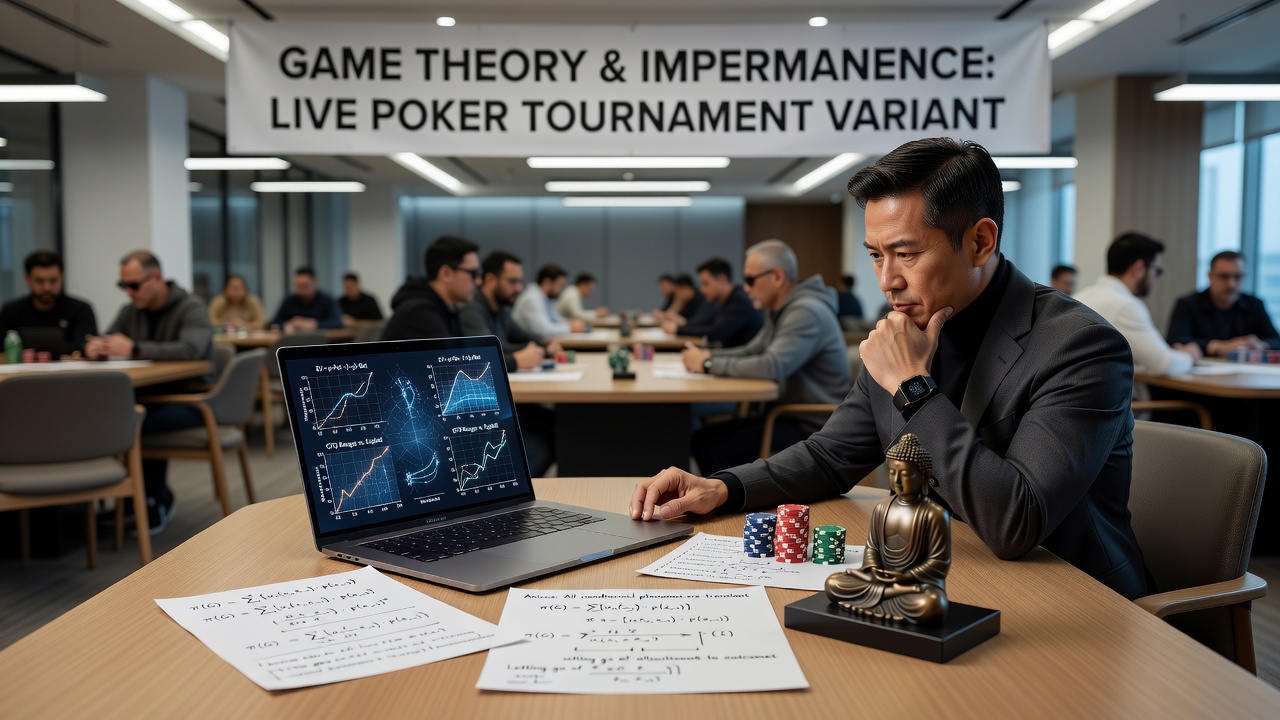
Case examples include tournament professionals who review hand histories through both lenses: first confirming that a line matched game theory recommendations, then examining any residual emotional residue through impermanence meditation before the next orbit. Data collected across multiple series indicate that such combined routines correlate with fewer tilt-induced deviations in later stages of events.
Observed Patterns in 2026 Events
Reports from international circuits during 2026 highlight increased discussion of these integrated methods among mid-stakes and high-stakes fields, and industry analyses attribute part of the trend to accessible online resources that present both mathematical models and secular mindfulness frameworks. Tournaments held that year featured side discussions and workshops where participants shared methods for logging solver suggestions alongside reflective notes on the transient quality of stack sizes. Regulatory bodies outside the UK, such as those in Australia and Canada, have tracked player behavior metrics that indirectly reflect steadier decision patterns when variance management incorporates both technical and philosophical elements.
Academic sources including university studies on decision science under uncertainty further support the observation that dual frameworks reduce certain cognitive biases that amplify variance effects. One such paper from a North American research institution examines how acceptance of change complements probabilistic reasoning in repeated high-stakes choices.
Conclusion
Live poker tournament variance continues to draw attention from those who apply game theory calculations alongside secular Buddhist concepts of impermanence, and available evidence shows measurable intersections in decision consistency and emotional regulation. As events progress through 2026 and beyond, further documentation of these combined approaches may clarify their role in long-term performance stability across diverse player populations.